
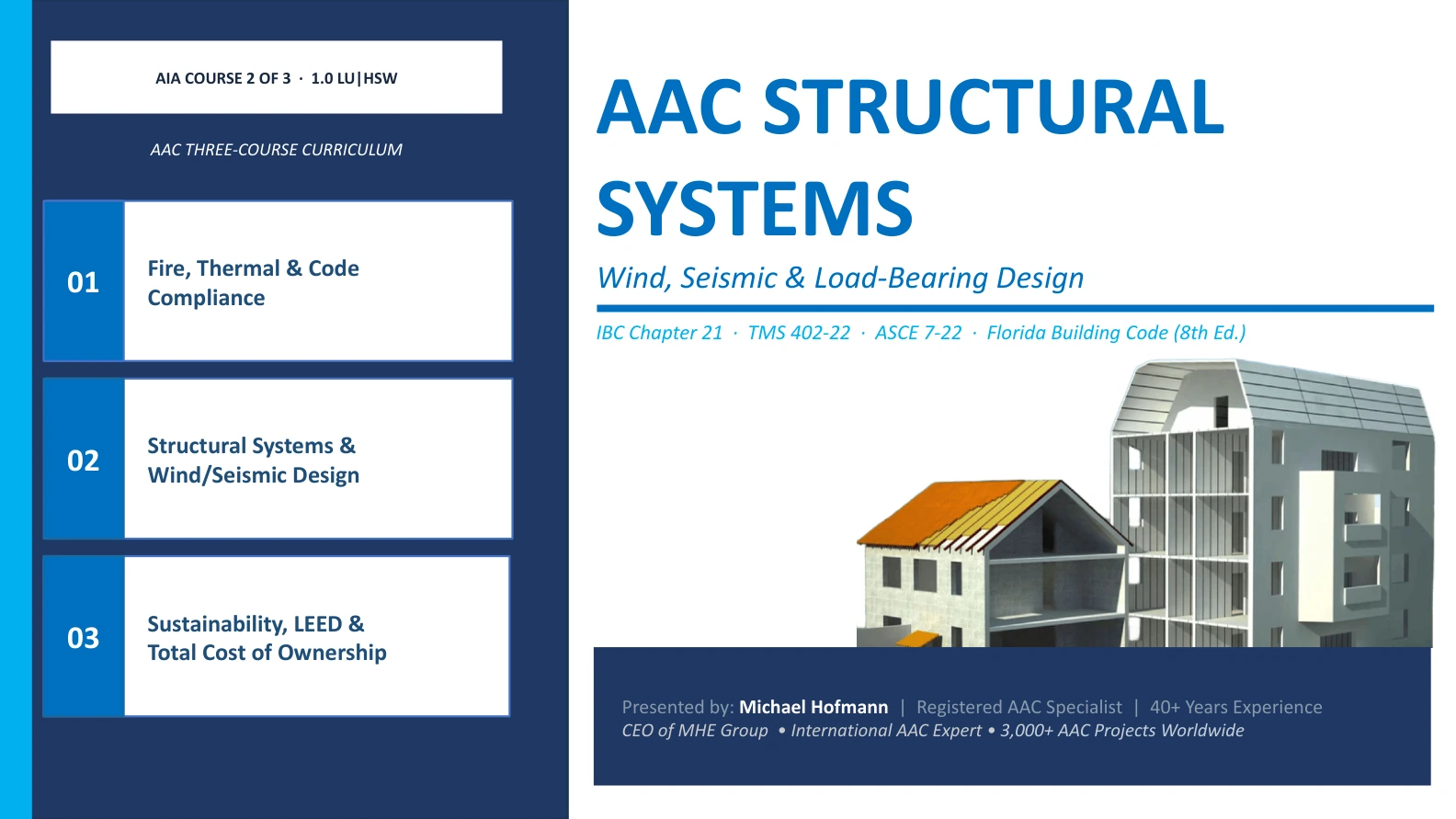
A focused AIA Continuing Education course exploring AAC structural systems, wind load design, seismic applicability, load-bearing wall logic, critical connections, and code-aware design references for architects, engineers, and construction professionals.
 1.0 LU|HSW
This course gives architects, engineers, developers, and construction professionals a structured overview of AAC structural systems, including strength grades per ASTM C1693, load-bearing wall systems, ASCE 7-22 wind load requirements, Florida HVHZ considerations, seismic applicability, TMS 402-22 and IBC Chapter 21 references, critical connections, and project-specific engineering review pathways. For applied design and documentation support, review MHE's AAC specialist services.
This page presents a summary, downloadable PDF, and selected preview pages so visitors can understand the value of the session before requesting live training.
Summary and preview pages only — use the downloadable PDF or request a live session.
Four AIA HSW learning objectives reviewed through a structural simulation framework.
Identify the structural properties of AAC and its density / strength grade classifications per ASTM C1693 and TMS 402.
Evaluate the MHE AAC Load-Bearing System for low-rise construction without a reinforced concrete frame, including wall, lintel, and bond beam detailing.
Apply AAC wall and panel systems to ASCE 7-22 wind load requirements, including Florida High-Velocity Hurricane Zones / HVHZ and Product Approval pathways.
Evaluate AAC seismic applicability in SDC A–C per ASCE 7-22 Table 12.2-1 and TMS 402-22 Chapters 7 and 11; identify when separate steel / concrete lateral systems are required in SDC D and higher.
Eight structural learning modules — summary only. Full content delivered by session.
AAC density, strength classification, and material behavior per ASTM C1693.
Summary only — full content by session
Selected page previews shown as summary visuals only. Click any preview to enlarge it.
Nine structural learning areas covered in the course — summary only.
Material behavior, compressive strength, and structural characteristics.
Density and strength grade classifications per ASTM C1693 and TMS 402.
Low-rise load-bearing AAC wall system design without reinforced concrete frame where permitted.
Wall system, lintel, bond beam, vertical reinforcement, foundation interface, and wall-to-roof tie.
ASCE 7-22 wind load design requirements and system applicability for AAC wall and panel systems.
Florida HVHZ requirements, FBC 8th Edition, and Product Approval pathways.
SDC A–C per ASCE 7-22 Table 12.2-1 and TMS 402-22. Lateral system requirements for SDC D+.
Foundation, vertical reinforcement, bond beams, lintel, and wall-to-roof tie connections.
Final structural values, approvals, and project application require project-specific engineering review.
International Building Code masonry provisions governing AAC structural applications.
Building Code Requirements and Specification for Masonry Structures.
Minimum Design Loads — wind load, seismic design categories, and load combinations.
Florida-specific provisions including HVHZ and Product Approval pathways.
This course introduces AAC structural system concepts and code-reference awareness.
Final structural values, approvals, detailing, ESR confirmation, wind design, seismic design, and project application require project-specific engineering review.
Presented by Michael Hofmann, Registered AAC Specialist and international AAC expert with 40+ years of experience and 3,000+ AAC projects worldwide. As Founder and Registered AAC Specialist of MHE Group, Michael brings deep AAC technical experience to every AIA education session.

Use the Course 2 PDF as a professional structural AAC education resource, or book MHE's live session on wind design, seismic applicability, load-bearing walls, code references, and project-specific engineering awareness.