
Total Cost of Ownership & Green Building Performance
Course 3 completes MHE's AAC education curriculum with a careful sustainability framework for architects, engineers, developers, and construction professionals evaluating AAC through LEED, GBCI, energy-code, embodied-carbon, and 30-year total cost of ownership lenses.
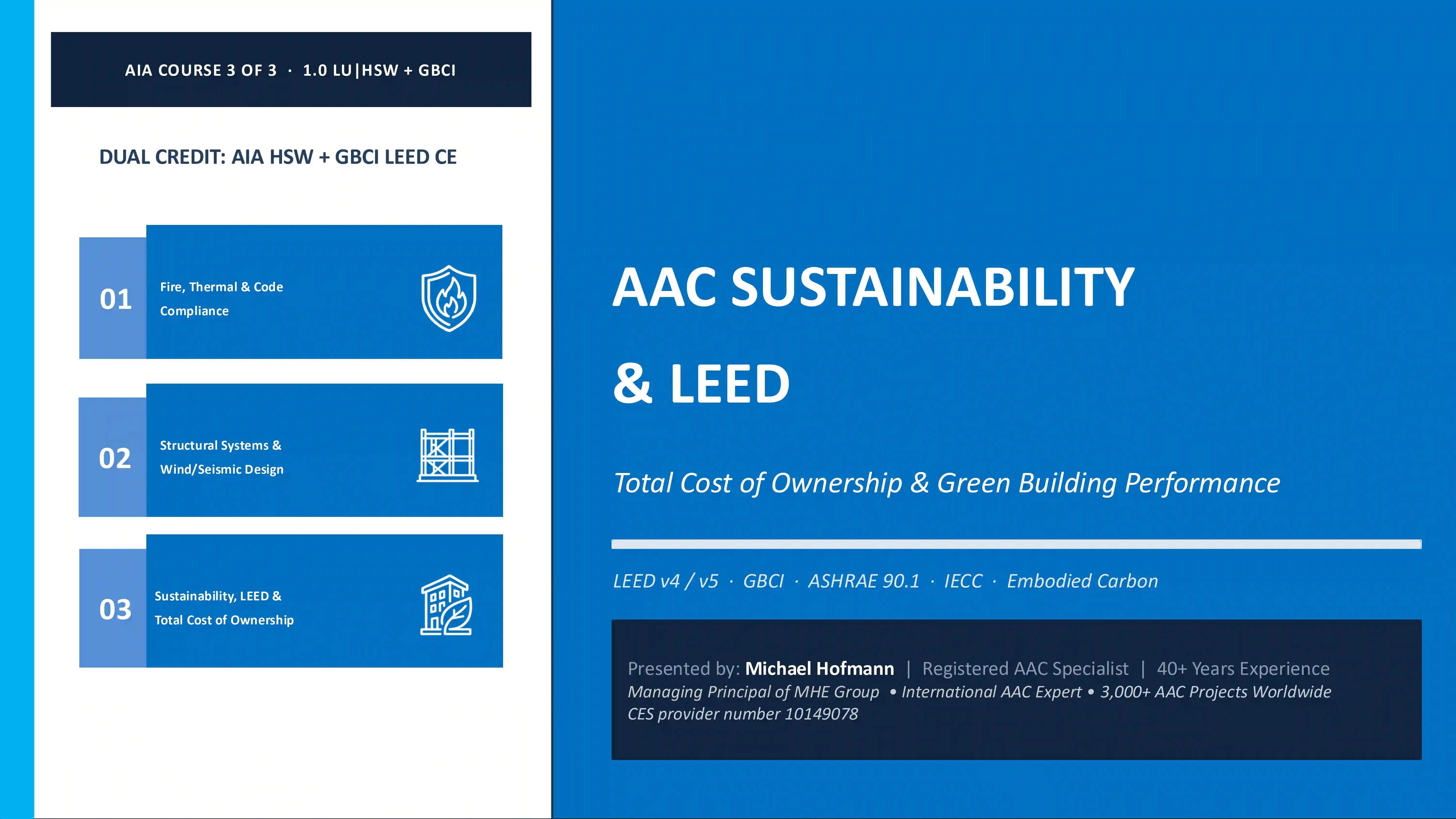 1.0 LU|HSW + GBCI
This course introduces a structured way to discuss AAC in green-building projects: embodied carbon and lifecycle assessment, LEED credit-category mapping, ASHRAE 90.1 and IECC energy-code context, 30-year total cost of ownership, and broader rating-system awareness.
The course supports MHE's education and resource positioning while keeping rating-system claims responsible: final credit contributions, approvals, savings, and documentation outcomes depend on the specific project and reviewer process.
Summary and preview pages only — full downloadable PDF provided for this course.
Four professional objectives reviewed through an AAC sustainability and green-building framework.
Calculate embodied carbon, recycled-content, and regional-sourcing advantages of AAC compared with CMU, ICF, and wood-frame assemblies as project-specific evaluation inputs.
Map AAC properties to selected LEED credit categories across Energy & Atmosphere, Materials & Resources, Indoor Environmental Quality, Sustainable Sites, and Water Efficiency where documentation supports review.
Perform a 30-year TCO analysis that considers first cost, operating cost, energy performance, durability, maintenance, and project-specific assumptions.
Identify U.S. regional sustainability drivers including energy-code compliance, wind/seismic resilience, mold prevention, and insurance-premium strategy discussions, with AIA LU|HSW and GBCI CE positioning.
Eight course modules — summary only. Full content is available in the downloadable PDF.
AAC material and wall-system evaluation through lifecycle, sourcing, and embodied-carbon lenses.
Full content in downloadable PDF
All 17 course pages are available as summary previews. Click any preview to enlarge it.
Nine learning areas covered in the course — framed as education and project-specific evaluation support.
Lifecycle material impact and sourcing conversations for AAC project teams.
Potential credit-category alignment subject to project documentation and reviewer approval.
Thermal-envelope and energy-code discussion connected to ASHRAE 90.1 and IECC.
Cost-of-ownership framework covering capital, operating, maintenance, and lifecycle inputs.
Moisture, acoustic, fire, and comfort considerations relevant to occupant health and welfare.
Wind, seismic, moisture, and insurance strategy topics framed as project-specific planning inputs.
LEED, WELL, Passive House, and FORTIFIED are introduced as separate frameworks with distinct requirements.
AIA HSW plus GBCI LEED CE positioning; GBCI dual credit is noted as pending approval where applicable.
No credit, savings, approval, or insurance outcome is guaranteed without project-specific review.
Credit-category awareness for energy, materials, indoor environmental quality, and related documentation pathways.
Dual-credit education positioning with GBCI status handled as pending approval where applicable.
Energy-code context for envelope, thermal, and operating-cost discussions.
Cost analysis framework based on project-specific assumptions rather than guaranteed savings.
This course introduces AAC sustainability concepts, rating-system awareness, and cost-model thinking.
LEED/GBCI credit contributions, reviewer decisions, energy outcomes, insurance discussions, and total cost of ownership results depend on project-specific documentation, assumptions, local conditions, and third-party review.
Presented by Michael Hofmann, Registered AAC Specialist and international AAC expert with 40+ years of experience and 3,000+ AAC projects worldwide. As Founder and Registered AAC Specialist of MHE Group, Michael connects AAC material knowledge with practical green-building and lifecycle decision-making.

Use the Course 3 PDF as a professional education resource for AAC sustainability, LEED alignment, energy-code awareness, and total cost of ownership discussions. For live training or project-specific AAC support, contact MHE.